Could you afford to retire earlier? Spend more on holidays? Help your children buy a home without putting your own financial security at risk?
Cashflow modelling helps you explore these questions by bringing your income, spending, pensions, savings and future plans together in a financial forecast.
At Jones & Co, we use cashflow modelling as part of our lifestyle financial planning. It helps you see how different decisions could affect your finances, so you can plan around the life you want to lead. The results are projections, not promises. Their value comes from understanding the assumptions, comparing alternatives and identifying where your plan may need to change.
What Is Cashflow Modelling?
Cashflow modelling, also written as “cash flow modelling”, is a way of projecting your personal finances over time.
It considers what you have now, the income you expect to receive and what you may need to spend. It then explores how those figures could change throughout your lifetime.
A model can help answer questions such as:
- When could I afford to retire?
- How much could I spend each year?
- What happens before my State Pension starts?
- Could I afford a large gift to my family?
- How might inflation or a market downturn affect my plans?
- What would happen if I lived longer than expected?
Unlike a monthly budget, which focuses on managing your immediate income and expenses, lifetime cashflow modelling looks at the relationship between today’s decisions and tomorrow’s needs.
Business cashflow forecasting serves a different purpose: tracking a company’s expected receipts and payments. This article focuses on personal financial planning.
How Does Cashflow Modelling Work?
A useful model starts with two things: an accurate picture of your finances and a clear understanding of your goals.
Your financial information might include pensions, investments, savings, earnings, debts and household spending. Your goals might include retirement, travel, reducing working hours or supporting your family.
The next step is to make assumptions about factors such as inflation, investment returns, tax, charges and future spending.
Those assumptions need to be reasonable and explained clearly. The Financial Conduct Authority’s guidance on cashflow modelling emphasises accurate information, justified assumptions, consideration of tax and charges, and testing uncertainty.
Different scenarios can then be compared. You might look at retiring at 60 rather than 65, spending more in the early years of retirement or making a substantial gift.
The purpose is to understand the consequences of those choices before you commit.
A Cashflow Modelling Example: Retiring at 60 Versus 65
Imagine a fictional couple, Alex and Sam, both aged 60.
They have £500,000 in accessible savings and investments available to support retirement. They want to spend £30,000 a year and are considering whether to retire now or work until 65.
For this simplified example, assume:
- Their combined income from other sources starts at 67 and provides £20,000 a year after tax.
- That income and their spending maintain their purchasing power.
- If they work until 65, earnings cover their spending until then.
- Their savings earn no return above inflation.
- There are no additional contributions, withdrawal taxes or charges in the illustration.
- Their home is excluded from the available savings.
These are invented assumptions for explaining the arithmetic. They are not a client case study, a State Pension entitlement estimate or a complete retirement forecast.
| Scenario | Withdrawals before age 67 | Withdrawals from age 67 | What the simplified calculation shows |
|---|---|---|---|
| Retire at 60 | £30,000 a year for seven years | £10,000 a year | £290,000 remains at 67; the savings balance reaches zero at approximately 94. |
| Retire at 65 | £30,000 a year for two years | £10,000 a year | £440,000 remains at 67; approximately £150,000 remains at 95. |
| Retire at 60, spend £35,000 a year and give away £25,000 immediately | £35,000 a year for seven years | £15,000 a year | £230,000 remains at 67; the savings balance reaches zero at approximately 82–83. |
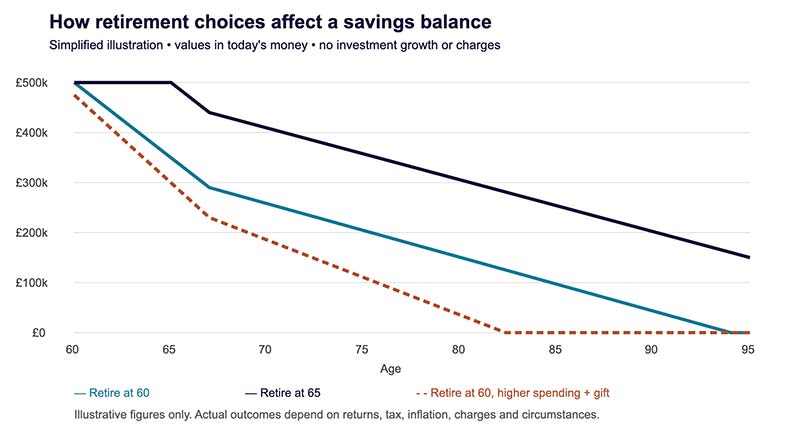
The horizontal axis shows age. The vertical axis shows the remaining savings balance in today’s money. Figures use simplified continuous spending assumptions; actual withdrawal timing would affect the balances.
The example shows why retirement planning involves more than knowing the size of your pension or investment pot. Five extra years of work, a higher spending target or a one-off gift can substantially change the picture.
A line reaching zero means the savings included in this illustration have been exhausted. It does not mean every source of income has disappeared: the assumed £20,000 annual income continues, but it no longer covers the full spending target.
A personal model would need to account for actual pension access, taxation, investment returns, charges, income dates and changing expenditure.
What Can Cashflow Modelling Tell You About Retirement?
Cashflow modelling can help reveal when your finances may come under pressure.
For example, retiring before another income source starts could create a period when you rely heavily on savings. Later, pension income may reduce the amount you need to withdraw.
It can also help you consider whether spending should change over time. You might want more money for travel early in retirement, while allowing for home maintenance or potential care costs later.
As part of retirement planning, modelling can help you compare:
- Different retirement dates.
- Full retirement with a gradual reduction in working hours.
- Different levels of essential and discretionary spending.
- Keeping savings available versus making gifts.
- Alternative ways of meeting an income shortfall.
A projection that appears comfortable is still worth examining closely. Understanding what could undermine it is part of making an informed decision.
Testing Inflation, Market Falls and Unexpected Spending
A single projection cannot capture every possible future.
Stress testing changes assumptions to explore what could happen if circumstances are less favourable.
Higher inflation: Food, energy, travel and other costs may rise faster than expected. Your income may not increase at the same pace.
Lower investment returns: Investments may deliver less growth than assumed, leaving less money available for future withdrawals.
A market fall early in retirement: Taking withdrawals while investments have fallen can make recovery more difficult. The timing of returns matters alongside their average level.
Unexpected expenses: Property repairs, family support or care needs can create spending that a basic budget overlooks.
A longer retirement: Planning should consider the possibility that you live beyond average life expectancy.
These tests help identify possible adjustments, such as changing spending, retaining a larger reserve or reconsidering retirement timing. Decisions about investments should also reflect your ability to absorb losses and your attitude to risk. Find out more about our investment advice.
What Information Should You Bring?
You do not need to arrive with a completed spreadsheet. However, gathering relevant information helps make the discussion more useful.
Useful documents and details include:
- Recent pension statements and contribution information.
- Savings, ISA and investment balances.
- A State Pension forecast.
- Mortgage balances and other debts.
- Earnings and other income.
- Regular household expenditure.
- Planned purchases, travel or family gifts.
- Existing insurance and financial commitments.
Separate essential spending, such as housing and food, from spending you could adjust, such as holidays.
Your goals matter just as much as the numbers. Think about what you want retirement to look like and which plans are most important to you.
What Happens During a Cashflow Modelling Discussion?
At Jones & Co, cashflow modelling forms part of a wider conversation about your financial position and the life you want to lead.
A useful discussion covers your current finances, future goals and the choices you want to explore. It should also address the assumptions behind the projections and how changes could affect the results.
When arranging advice, ask what the agreed service includes. For example:
- Will you receive a written explanation and copies of the illustrations?
- Which scenarios will be compared?
- How will tax, inflation and charges be treated?
- Does the service include recommendations?
- When will the model be reviewed?
You should come away understanding the main findings, the uncertainties and any proposed next steps. A graph is helpful only when you can interpret what it means.
Using Cashflow Modelling to Support Your Family
You may want to help children or grandchildren while protecting your own retirement.
Modelling can explore the effect of a gift on your future finances, including whether you could still meet essential spending under less favourable conditions.
However, being able to afford a gift and understanding its tax consequences are separate questions. Cashflow modelling can support the affordability discussion, while inheritance tax planning considers the wider estate-planning implications.
What Are the Limitations?
Cashflow modelling cannot predict future markets, tax rules, health or personal circumstances.
Results depend on the information entered and the assumptions used. Small differences, repeated over many years, can materially change a projection.
Ask your adviser:
- Are figures shown in today’s money or future pounds?
- Are investment and advice charges included?
- How are taxes on income and withdrawals treated?
- What happens if returns are lower or spending is higher?
- What does the model assume about longevity?
Understanding these points helps you use the results appropriately.
When Should You Review Your Plan?
Review the model when there is a meaningful change to your finances or goals.
That might include retirement, a change in income, an inheritance, a major gift, new family commitments or a substantial change in spending.
Investment performance, inflation and tax changes may also affect the assumptions.
Agree a review schedule with your adviser so the model remains relevant to your circumstances.
Frequently Asked Questions
Can cashflow modelling tell me whether I can retire early?
It can help assess whether early retirement appears affordable under stated assumptions. Comparing retirement dates and less favourable scenarios can highlight potential shortfalls and trade-offs.
How much does cashflow modelling cost?
Costs depend on the scope of the service and whether modelling forms part of wider financial advice. Ask Jones & Co what is included and how initial advice and ongoing reviews are charged before proceeding.
Can I use cashflow modelling software myself?
Software can help you explore scenarios, but you still need to understand its assumptions and limitations. Professional advice can help interpret the results alongside pensions, investments, tax and personal goals.
Is cashflow modelling only useful near retirement?
No. It can also help you explore reducing working hours, funding education, selling a business or making substantial family gifts.
Discuss Your Financial Future With Jones & Co
Cashflow modelling can help you understand the relationship between your money and your plans.
Whether you are considering retirement, changing your spending or helping your family, Jones & Co can help you explore your options through personal financial planning.
Contact Jones & Co to discuss your goals or call 01246 550 521
Cashflow modelling uses assumptions and projections, not guaranteed outcomes. The value of investments can fall as well as rise, and you may get back less than you invest. Tax treatment depends on individual circumstances and may change.